

Introduction
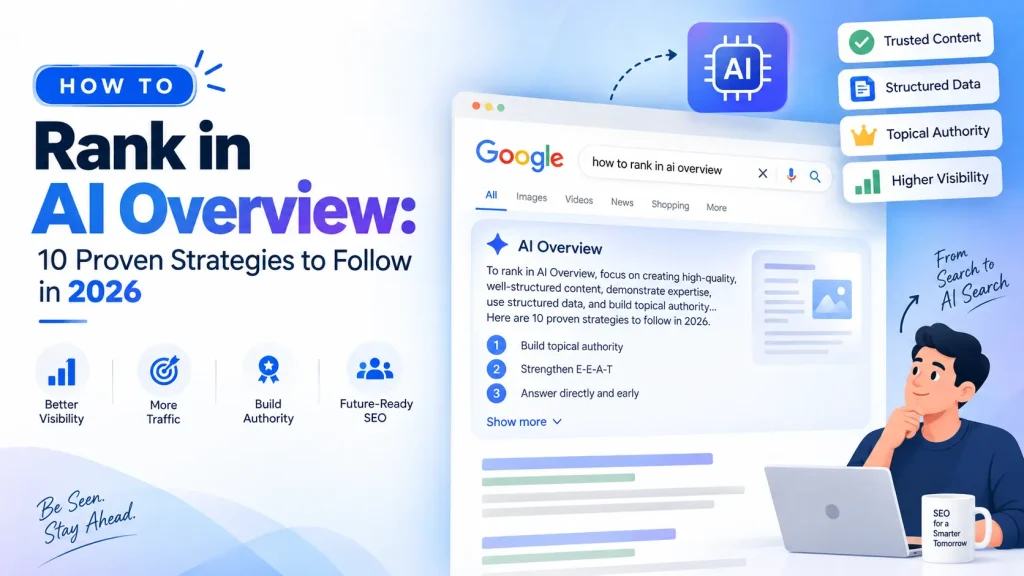
Google’s AI Overview has fundamentally changed how people discover information online. Instead of scanning ten blue links and clicking through to compare pages, users now see a synthesized, AI-generated answer sitting right above the traditional organic results — often built from just three to five trusted sources. If your website isn’t one of those sources, you’re effectively invisible to a large and growing share of searchers, regardless of how well you rank in the classic sense.
Learning how to rank in AI Overview is no longer a “nice to have” for brands that depend on organic visibility — it’s becoming central to survival in search. It requires a genuine shift in approach: from writing purely to satisfy crawlers and keyword density checks, to writing for AI-generated search results that read, interpret, summarize, and cite content the way a well-informed human editor might. Below are ten detailed, proven strategies, grounded in real SEO practice, to help your website earn a place in Google’s AI Overview and similar generative search experiences like ChatGPT and Perplexity.
1. Build Genuine Topical Authority, Not Just Isolated Pages
AI Overview systems, much like Google’s Search Generative Experience (SGE) before it, favor domains that demonstrate depth across an entire subject area rather than a single well-optimized page competing in isolation. When a website publishes a tightly interlinked cluster of articles covering every meaningful angle of a topic — definitions, comparisons, how-to guides, and FAQs — it signals topical authority far more convincingly than one standalone post ever could.
In practice, this means mapping out a content silo before you write a single article. Identify the core pillar topic, the supporting subtopics, and the long-tail questions searchers actually ask. Structuring your site around these themes, supported by consistent and strategically planned content writing, helps AI models recognize your domain as a comprehensive, reliable knowledge source rather than a one-off contributor.
2. Strengthen E-E-A-T for AI Search
Experience, Expertise, Authoritativeness, and Trustworthiness remain central to Google’s Search Quality Rater Guidelines, and early evidence suggests AI Overview weights these signals even more heavily than traditional ranking factors when deciding which sources to cite. This makes sense: an AI system summarizing information to millions of users needs to minimize the risk of citing something inaccurate or unverifiable.
Practical E-E-A-T signals include visible author bylines with real credentials, first-hand case studies, original research or data, transparent sourcing of statistics, and clear “About” and contact information. Content written by named experts with demonstrable, on-the-ground experience in the subject consistently outperforms anonymous or thin AI-generated filler. If your brand hasn’t invested in an authoritative About page or clear author profiles, this is one of the highest-leverage fixes available.
3. Answer the Core Question Directly and Early
AI Overview optimization rewards content that answers the searcher’s actual question within the first two or three sentences, before diving into supporting detail. This mirrors exactly how featured snippets have always worked — except now the stakes are higher, because the AI model is deciding whether your phrasing is clean enough to summarize accurately or whether it should look elsewhere.
Avoid long, scene-setting introductions before getting to the point. A direct, well-formed answer near the top of the page, followed by context, examples, and nuance further down, gives both human readers and AI crawlers exactly what they need without forcing them to hunt for it.
4. Use Structured Data for AI Search
Schema markup — including FAQ, HowTo, Article, Organization, and Review schema — helps AI systems parse your content’s meaning, hierarchy, and context with far greater precision than plain HTML alone. Structured data for AI search doesn’t guarantee inclusion in AI Overview, but it removes ambiguity, making it significantly easier for generative engines to extract, attribute, and correctly represent your content.
At a minimum, every blog post or service page should carry Article schema, and any page containing a genuine FAQ section should carry FAQPage schema. This small technical investment compounds over time as more of your site becomes machine-readable.
5. Optimize for Conversational and Semantic Search
AI-generated search results respond to natural, conversational queries rather than fragmented, keyword-stuffed phrasing. Semantic SEO and entity SEO matter far more today than exact-match keyword density. Write the way real people actually speak and search — using related terms, synonyms, and surrounding context that reinforce topical relevance naturally, without forcing awkward repetition.
This is also where Natural Language Processing (NLP) principles come into play. Search engines increasingly evaluate content based on entities and relationships between concepts, not isolated keywords, so building content around a clear semantic field strengthens your relevance signals across both traditional and AI search.
6. Format Content for Easy Extraction
Bullet points, numbered lists, short paragraphs, comparison tables, and clear descriptive subheadings make content dramatically easier for AI models to lift and summarize accurately. Zero-click search behavior is now common — a large share of queries are fully answered without a single click — so structuring your page as a scannable, extractable resource increases your odds of citation even when the click never happens.
A useful test: read your own subheadings in isolation. If they form a coherent outline of the answer on their own, an AI summarizer will likely be able to do the same.
7. Publish Original Data, Insights, and Case Studies
Generative Engine Optimization consistently favors originality over rehashed information. AI models are effectively trained to avoid redundant or duplicated content, so material backed by proprietary research, internal data, client case studies, or genuine firsthand industry insight stands out far more than generic advice repeated across a thousand competing pages.
This is also where real experience separates authoritative brands from content mills. A campaign result, a before-and-after metric, or a specific client outcome carries far more weight — and citation potential — than a rewritten definition anyone could find elsewhere.
8. Maintain Strong Technical Health and Core Web Vitals
A technically sound website remains foundational to any AI search optimization effort. Fast load times, mobile responsiveness, clean crawlability, and healthy Core Web Vitals scores affect whether your pages get indexed, crawled frequently, and seriously considered at all — long before content quality even enters the equation.
Pairing solid technical SEO with strong on-page content gives AI Overview systems fewer reasons to skip your site in favor of a faster, cleaner competitor.
9. Build Cross-Platform and Cross-Channel Authority
AI search optimization isn’t confined to Google’s algorithm alone. Visibility across social platforms, coordinated search engine marketing campaigns, and consistent digital PR all contribute to how large language models — including those powering ChatGPT SEO and Perplexity AI SEO — perceive your brand’s overall authority and trustworthiness as an entity on the web.
A coordinated approach that combines social media optimization with search engine marketing reinforces the entity signals that AI systems increasingly rely on when connecting a brand name to a body of trustworthy work across the internet.
10. Keep Content and Digital Assets Organized and Updated
Outdated statistics, broken links, and inconsistent messaging quietly erode trust signals over time, even on pages that once performed well. Regularly auditing and refreshing published material, along with maintaining well-organized digital assets, ensures AI models continue to see your site as current, accurate, and dependable rather than stagnant.
A simple quarterly content audit — checking dates, statistics, broken internal links, and outdated screenshots — goes a long way toward preserving the trust you’ve already built.
How Google AI Overview Chooses Content
Google’s AI Overview draws on Search Generative Experience (SGE) technology, pulling from indexed pages that demonstrate strong topical relevance, credible sourcing, and clean structured formatting. It tends to favor pages that already perform well organically, carry clear entity associations within Google’s Knowledge Graph, and satisfy user search intent efficiently and directly. There’s no real shortcut here — AI Overview is best understood as an extension of solid SEO fundamentals, with AI-specific formatting, semantic clarity, and trust signals layered carefully on top.
Want to Grow Your Business Online
Get a Free Consultation From Our Digital Marketing Expert
Frequently Asked Questions
How do I optimize my website for Google AI Overview?
Focus on topical authority, structured data, and direct answers within the first few sentences of your content. Strengthen E-E-A-T signals through expert authorship and original insights. Combine this with strong technical SEO, semantic clarity, and consistent content updates to improve your chances of appearing in AI Overview results.
What are the best practices to rank in AI Overview?
Best practices include answering questions concisely, using FAQ and HowTo schema, writing in a natural conversational tone, and building topical depth across related pages. Original data, case studies, and clear source attribution also help AI systems trust and cite your content over generic competitors.
Is AI Overview optimization different from traditional SEO?
Not entirely. AI Overview optimization builds on traditional SEO fundamentals like relevance, authority, and technical health, but adds emphasis on extractable formatting, semantic clarity, and demonstrable expertise, since AI models summarize and synthesize content rather than simply ranking a list of pages.
How does Google AI Overview choose which content to cite?
It prioritizes pages with strong topical relevance, clean structure, and established trust signals, often favoring domains that already rank well organically. Entity recognition through the Knowledge Graph and clear, well-organized answers also significantly increase a page’s likelihood of being cited.
How to Rank in AI Overview
Ranking in AI Overview requires creating authoritative, well-structured, and user-focused content that directly answers search queries. Strengthen E-E-A-T, build topical authority, use schema markup, optimize for semantic search, and maintain excellent technical SEO to increase your chances of being cited in Google’s AI-generated search results.
Final Thoughts
Ranking in AI Overview isn’t about gaming an algorithm — it’s about becoming the source AI systems trust enough to cite in front of millions of users. That trust is earned gradually, through genuine expertise, clean content structure, technical reliability, and consistent value delivered to real people, not just search engines. If your team needs help building a comprehensive, AI-ready content and SEO strategy, get in touch with our team to discuss a tailored approach for your business.
Want to see how our strategies have helped other brands improve search visibility and earn AI citations? Learn more about our work and approach, or explore our SEO services to get started today.

Written By
Abhishek Jadhav
Abhishek is a Digital Marketing Strategist at MI Tech Solutions, Pune, specializing in SEO, content development, and performance marketing across Google and Meta. With experience in education, technology, and co-living sectors, he focuses on data-driven strategies, SEO-friendly content, and building strong online visibility.
Get a Expert Digital Marketing Tips
Subscribe to our newsletter and get the latest insights directly in your inbox